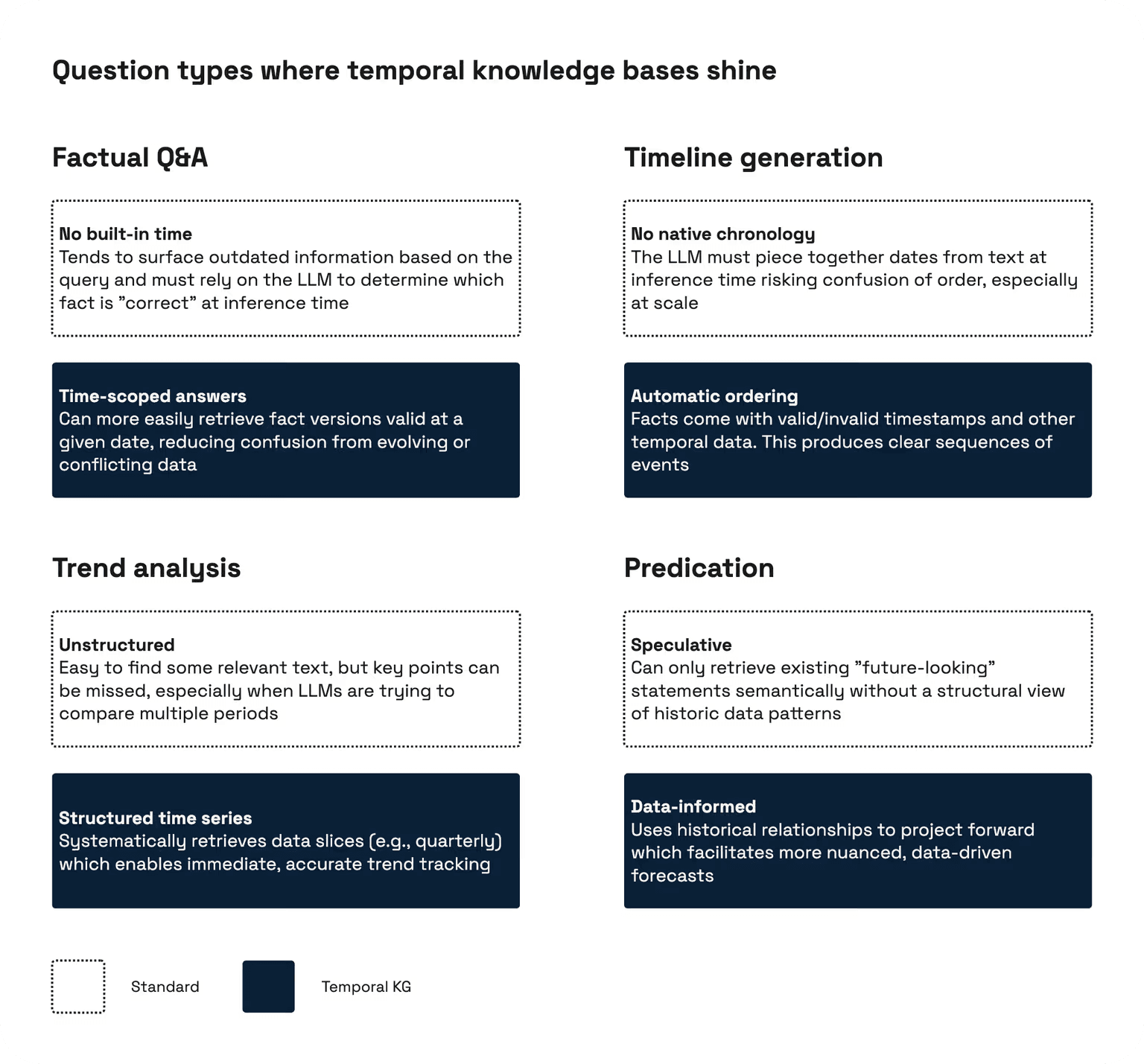
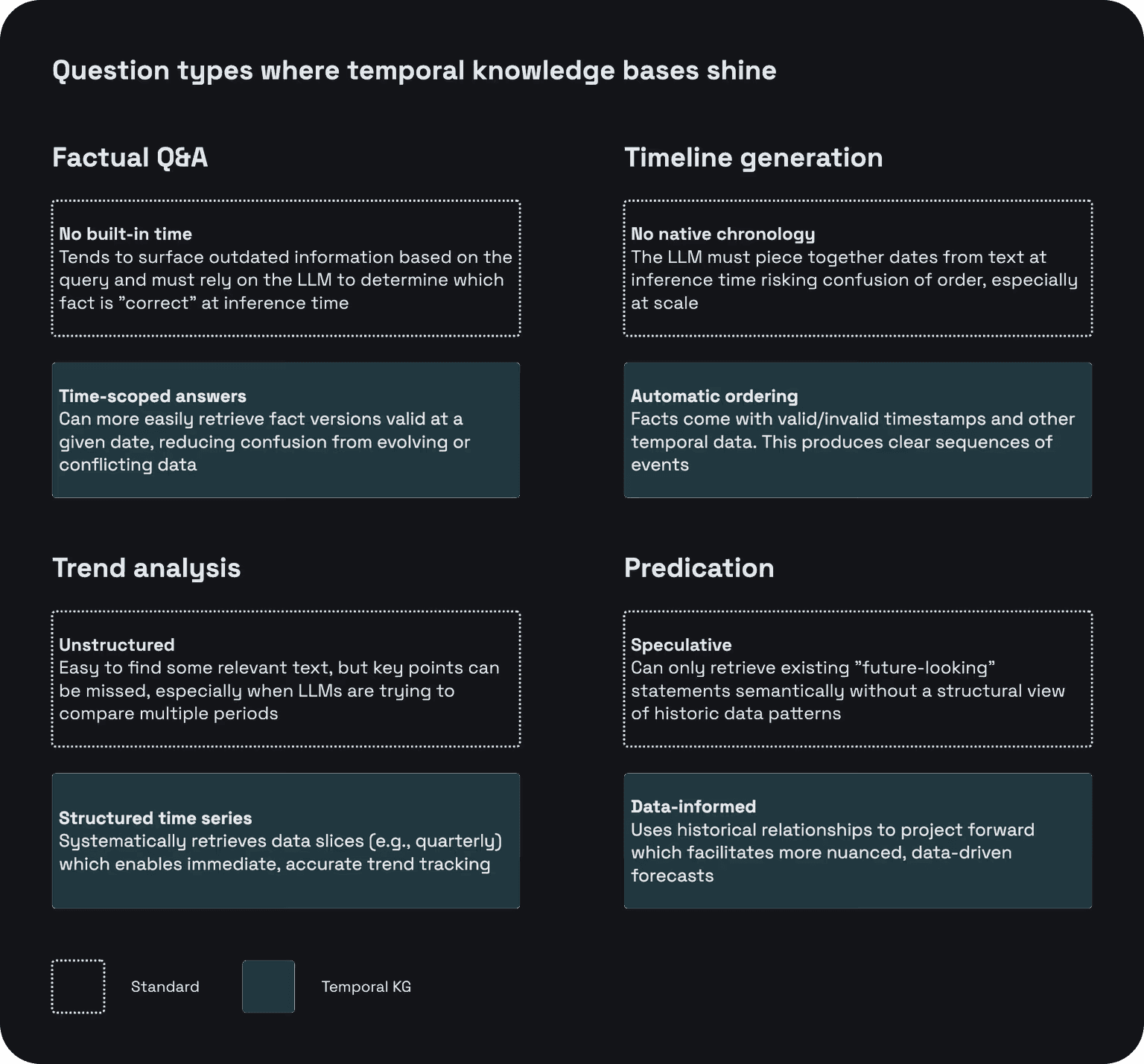
The Temporal Agent pipeline has a simple underlying logic.
Chunk the input
Start with a document (like a board transcript or annual report). Break it into manageable pieces (such as speaker turns or paragraphs).
Extract Statements
From each chunk, pull clear, standalone statements like: “Company X is a market leader.”
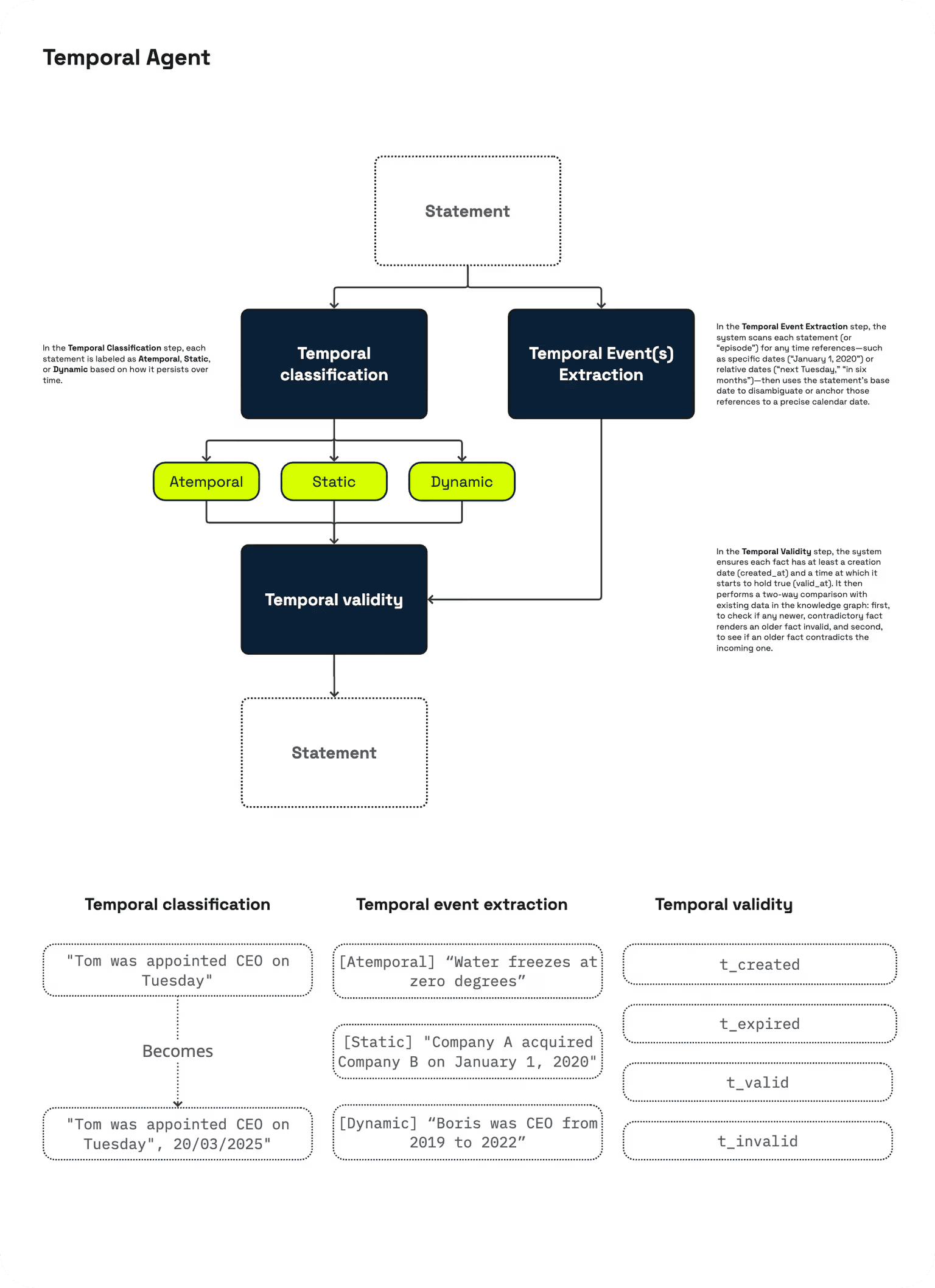
Label the Type
Fact (objective truth)
Opinion (subjective)
Prediction (forecast or estimate)
Static (true at a point in time)
Dynamic (may change over time)
Atemporal (timeless fact)
Understand the Timing
The agent detects when the statement became true, and (if needed) when it stopped being true (i.e., when it was invalidated). This relates to the validity of the information in the statement which may be different from when the statement was made or published.
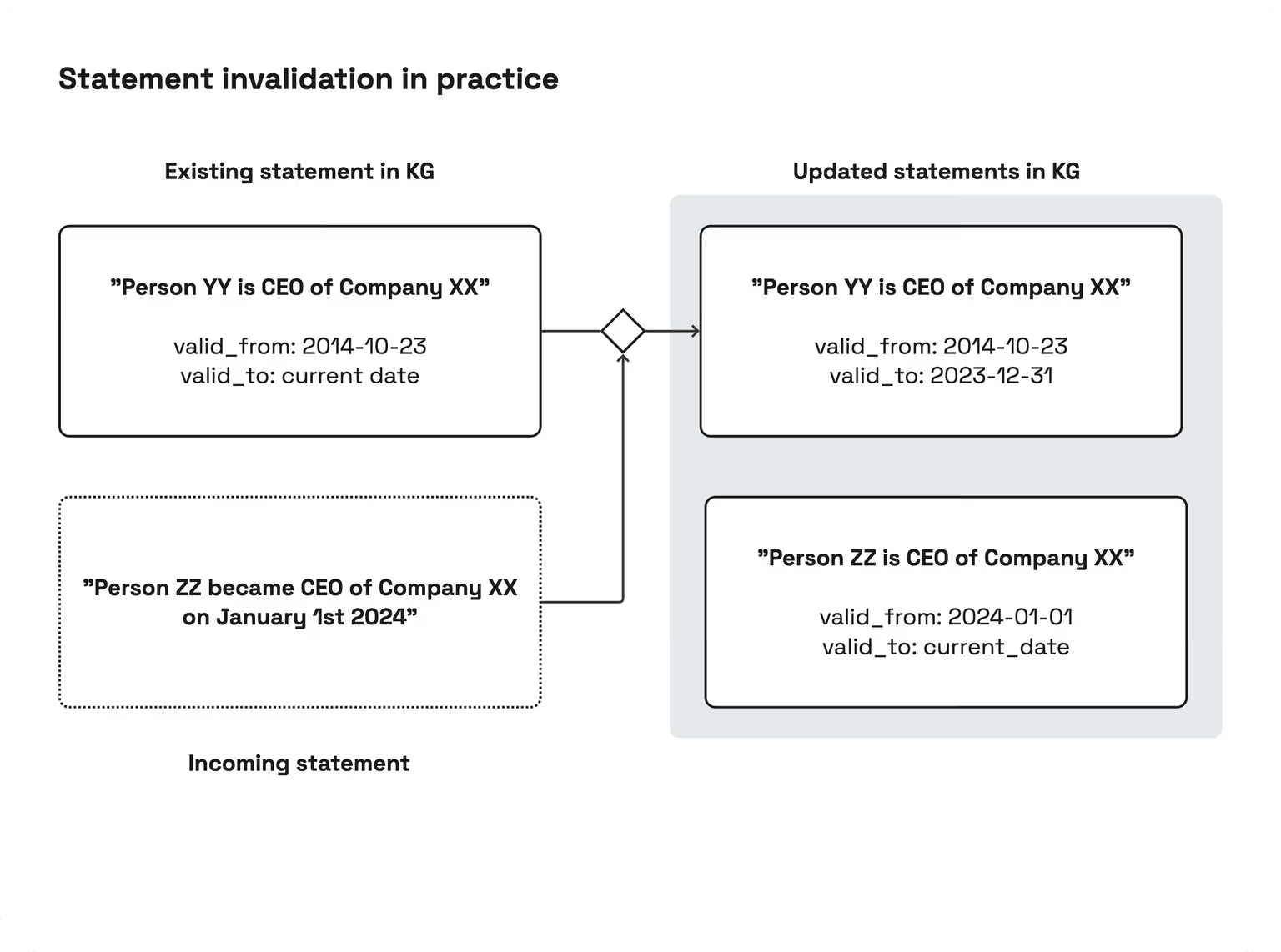
Check for Contradictions (Invalidation)
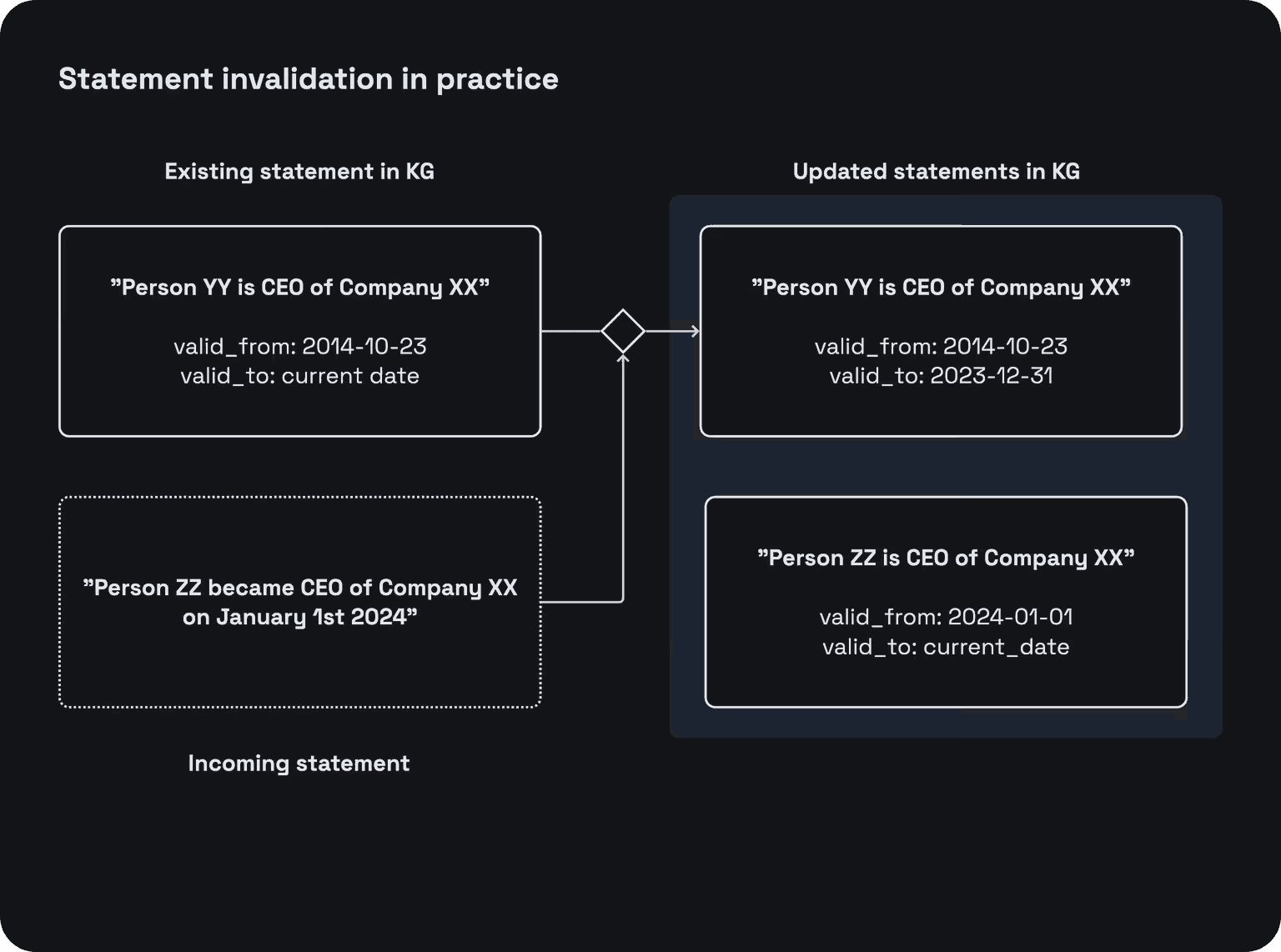
If a new statement contradicts an old one, the older entry is marked as expired and linked to the newer one rather than removing the invalidated information from the knowledge base altogether.
This process is both automated and traceable, meaning you can always look deeper to see what changed and why.
The good news? You don’t need to redesign your whole system. Temporal Agents can often integrate right into your existing RAG or knowledge pipeline architecture.
Key Components:
Semantic Chunking: Break raw text into meaningful parts.
LLM-Powered Fact Extraction: Use LLMs to identify facts, detect dates, and label event types.
Temporal Classification: Use LLMs to temporally classify statements and determine temporal validity ranges
Temporal Invalidation Logic: New facts can automatically update or expire older ones—no manual versioning.
Triplet-Based Storage: Each fact is stored as: [Subject]—[Action]—[Object] + [Start Time, End Time] if using knowledge graphs or a graph-based database.
With the right setup, even small teams can go from prototype to production in weeks. You can prototype with the larger models (GPT-4.1), then step down to faster versions (GPT-4.1-mini or nano) once stable. For a more technical deep dive into this, see the OpenAI Temporal Agents with Knowledge Graphs Cookbook.
So, you’ve got your temporally-aware knowledge graph sorted, and you can trust the data that’s in it. How can you translate this robust data foundation into business value?
Retrieving the information you want from large knowledge bases can be challenging. Multi-step retrieval agents can help with this. These systems can intelligently traverse across the knowledge base across multiple, interconnected queries to find the most relevant information to answer your query.
As your system scales, maintaining efficiency and optimizing performance becomes key. Incorporating planners can help to streamline retrieval, helping to focus the later stages of the retrieval pipeline on what’s important. Refining the search and analysis tools that your core system has access to can also delivery gains, enabling more complex queries to large knowledge graphs, without loss in speed or quality.
For high-volume deployments, moving to parallelise graph traversal, caching frequent query paths, and driving performance through further prompt refinements and fine-tuning can significantly boost performance.
For those building a Temporal Agent, we’ve open-sourced a full technical walkthrough in our OpenAI Cookbook on Temporal Agents with Knowledge Graphs, covering everything from extraction logic to multi-hop reasoning including:
Full code and pipeline blueprints
Model guidance and evaluation strategies
Best practices for scaling from prototype to production
Temporal Agents transform how AI understands your world—not as static facts, but as a living, evolving narrative.
When your decisions hinge on when something happened—not just what—it’s time to think temporal.
And you don’t have to build it alone. If you’re looking to make your systems more context-aware, decision-ready, or simply more aligned with reality—we’d love to help.